Redefining Reinforcement Learning: A Divide-and-Conquer Approach Beyond Temporal Difference
Introduction
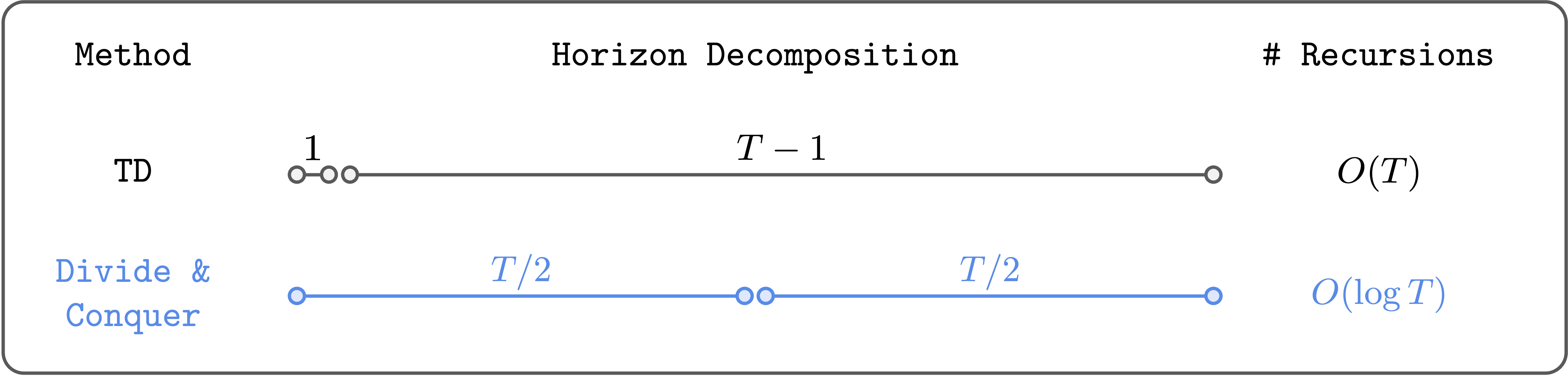
Reinforcement learning (RL) has traditionally relied on temporal difference (TD) learning to estimate value functions, but this approach struggles with long-horizon tasks due to error accumulation. An emerging alternative uses a divide-and-conquer strategy that bypasses TD learning entirely. This article explores the paradigm shift, examining why off-policy RL is challenging, the limitations of TD and Monte Carlo methods, and how a divide-and-conquer framework offers a scalable solution.
The Challenge of Off-Policy Reinforcement Learning
Off-policy RL is a flexible yet demanding setting where an agent can learn from any data—past experiences, human demonstrations, or even internet logs—without being restricted to its current policy. This contrasts with on-policy RL, which requires fresh data from the latest policy. While on-policy methods like Proximal Policy Optimization (PPO) and Group Relative Policy Optimization (GRPO) have scaled successfully, off-policy algorithms remain difficult to scale for complex, long-horizon tasks.
On-Policy vs Off-Policy
In on-policy RL, data is discarded after each policy update, making it inefficient for expensive domains like robotics or healthcare. Off-policy RL, epitomized by Q-learning and its variants, reuses data arbitrarily, which is crucial when collection costs are high. However, this flexibility introduces fundamental stability and scalability issues that current solutions have only partially addressed.
Why Off-Policy Matters
Applications such as dialogue systems, autonomous driving, and clinical decision-making rely on off-policy RL because they cannot afford to exhaustively sample new trajectories. As of 2025, no off-policy algorithm has demonstrated reliable scaling to tasks with long horizons—a gap that motivates the search for new paradigms.
Two Traditional Value Learning Methods: TD and Monte Carlo
Value learning in off-policy RL typically employs either Temporal Difference (TD) learning or Monte Carlo (MC) returns. Each has distinct trade-offs when applied to long-horizon problems.
Temporal Difference (TD) Learning and Its Limitations
TD learning updates the Q-function using the Bellman equation: Q(s, a) ← r + γ maxa' Q(s', a'). This bootstrapping mechanism—basing an update on a subsequent estimate—causes errors to propagate backward through the entire trajectory. In long-horizon tasks, these errors compound, leading to instability and poor performance. Despite its elegance, TD learning struggles when the number of steps between state–action pairs grows large.
Mixing TD with Monte Carlo Returns
To mitigate error accumulation, researchers combine TD with Monte Carlo returns. The n-step TD update uses actual rewards for the first n steps and bootstrapping thereafter: Q(st, at) ← Σi=0n-1 γi rt+i + γn maxa' Q(st+n, a'). This reduces the number of bootstrapping steps, and in the limit n = ∞, we recover pure Monte Carlo—no bootstrapping at all. While such hybrids often improve results, they remain unsatisfactory because they don’t address the root cause: reliance on iterative Bellman updates for value propagation.

The Divide-and-Conquer Alternative
An entirely different philosophy is to avoid TD learning altogether. Instead of propagating values step by step, a divide-and-conquer RL algorithm breaks the task into smaller, independent subproblems, solves each efficiently, and then combines the solutions.
Core Idea
The divide-and-conquer approach partitions a long-horizon task into shorter segments—either by temporal abstraction or state-space decomposition. Each segment is solved using Monte Carlo returns (which are unbiased but high-variance), but because the segments are short, the variance remains manageable. Critically, there is no bootstrapping between segments, so errors do not accumulate across the full horizon. This method aligns naturally with off-policy data reuse, as each segment’s solution can be learned independently from stored experiences.
Advantages for Long-Horizon Tasks
By eliminating temporal difference updates, the divide-and-conquer algorithm sidesteps the fundamental scalability bottleneck of conventional off-policy methods. It scales gracefully to tasks requiring thousands of steps, as demonstrated in recent benchmarks. Additionally, it inherits the data efficiency of off-policy learning while maintaining stability, because the value estimation for each segment is decoupled. Practitioners can also incorporate human knowledge by defining meaningful subgoals, further improving sample efficiency.
Conclusion and Outlook
The divide-and-conquer paradigm represents a promising departure from TD-based RL, especially for challenging long-horizon applications. While traditional TD learning and its n-step hybrids remain useful for many problems, they are not the only path. As research progresses, we may see more algorithms that replace bootstrapping with compositional structures, unlocking new capabilities for autonomous systems. For now, this alternative provides a fresh perspective on what scalable off-policy RL can look like.