10 Critical Facts About Russia's Router Hacking Campaign Targeting Microsoft Office Tokens
In a striking revelation from cybersecurity experts, a Russian state-sponsored hacking group has been exploiting outdated routers to steal authentication tokens from Microsoft Office users. This campaign, attributed to the GRU-linked Forest Blizzard (also known as APT28 or Fancy Bear), underscores the evolving sophistication of espionage operations that leverage network infrastructure rather than traditional malware. Below are ten essential facts about this covert operation, highlighting its scale, methods, and implications for global cybersecurity.
1. The Perpetrator: Forest Blizzard (APT28)
Forest Blizzard, also tracked as APT28 or Fancy Bear, is a threat actor directly tied to Russia's military intelligence unit, the GRU. This group gained notoriety for its involvement in the 2016 U.S. election interference, targeting the Democratic National Committee and Hillary Clinton's campaign. In this recent campaign, they leveraged their sophisticated capabilities to conduct a stealthy, large-scale espionage operation against Microsoft Office users globally. Their modus operandi focused on network-level attacks, bypassing traditional endpoint defenses.

2. Massive Scale: Over 18,000 Routers Compromised
At the peak of the operation in December 2025, Forest Blizzard had compromised more than 18,000 internet routers, spanning over 200 organizations and 5,000 consumer devices. The hacking group targeted a wide array of entities, including ministries of foreign affairs, law enforcement agencies, and third-party email providers. This scale indicates a systematic effort to infiltrate networks on a global level, leveraging compromised routers as access points to sensitive data.
3. Primary Targets: Government and Law Enforcement
The campaign focused heavily on government institutions, particularly ministries of foreign affairs and law enforcement bodies. Additionally, third-party email providers were singled out, suggesting an intent to intercept communications and steal credentials. By targeting these high-value organizations, the hackers aimed to gather geopolitical intelligence, potentially influencing diplomatic relations and national security policies.
4. Zero Malware Needed: DNS Hijacking Technique
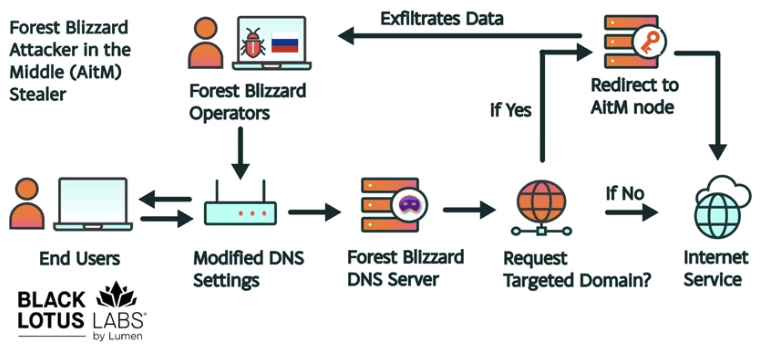
A remarkable aspect of this operation is that it required no malicious software or code. Instead, the hackers exploited known vulnerabilities in routers to modify their Domain Name System (DNS) settings. This technique, known as DNS hijacking, allowed them to redirect traffic from legitimate websites to malicious ones designed to steal login credentials and authentication tokens. The absence of malware made detection extremely difficult, as traditional antivirus tools found no traces of infection.
5. Vulnerable Devices: Older Mikrotik and TP-Link Routers
The compromised routers were predominantly older models from Mikrotik and TP-Link, marketed for Small Office/Home Office (SOHO) environments. Many were end-of-life or far behind on security updates, making them easy targets. The hackers did not need to install persistent malware; they simply altered the routers' DNS configurations through known flaws, allowing them to control network traffic without raising alarms.
6. How the Attack Worked: DNS Server Takeover
Once a router was compromised, its DNS settings pointed to virtual private servers controlled by the attackers. This change affected all users on the local network. When a user attempted to access a legitimate site, the malicious DNS server directed them to a fake version that captured their OAuth authentication tokens. Importantly, these tokens were transmitted only after the user had successfully logged in, making the theft simultaneous with normal activity.
7. Stolen Assets: Microsoft Office OAuth Tokens
The primary prize for the hackers was OAuth authentication tokens from Microsoft Office users. These tokens act as digital keys, granting access to email, files, and cloud services without requiring the password again. By intercepting these tokens, Forest Blizzard could seamlessly access Microsoft Office accounts, reading emails, accessing documents, and potentially moving laterally within target networks. The stolen tokens provided persistent access, bypassing multi-factor authentication mechanisms.
8. Silent and Simple: No Software Deployment
This campaign's simplicity is what made it so dangerous. The attackers didn't need to deploy malware on end devices or servers; they manipulated routers at the network edge. This allowed them to operate under the radar, as network monitoring tools looked for malicious signatures rather than configuration changes. The victims remained unaware until security researchers at Black Lotus Labs discovered the anomalous DNS patterns.
9. Discovered by Black Lotus Labs and Microsoft
The operation was uncovered by Black Lotus Labs, the security division of internet backbone provider Lumen, along with Microsoft's threat intelligence team. Their analysis revealed the extensive scope and technique, leading to a coordinated disclosure. Microsoft published a blog post detailing the findings, while the UK's National Cyber Security Centre (NCSC) issued an advisory to help organizations mitigate similar attacks.
10. Mitigation and Recommendations
To defend against such attacks, experts recommend replacing end-of-life routers with supported models, applying firmware updates promptly, and changing default passwords. Organizations should monitor for unauthorized DNS changes and consider using encrypted DNS protocols like DNS-over-HTTPS. Additionally, implementing conditional access policies and regularly rotating OAuth tokens can reduce the impact of token theft. The NCSC advisory provides specific guidance for network administrators to secure their infrastructure against Russian cyber activity.
In the landscape of modern cyber threats, this campaign demonstrates that even without deploying a single piece of malware, state-sponsored hackers can conduct large-scale espionage by targeting foundational network components. The key takeaway is the critical importance of router security—often overlooked in favor of endpoint protection. As these attacks evolve, both individuals and organizations must remain vigilant, updating hardware and configurations to thwart such stealthy incursions. The Forest Blizzard operation is a stark reminder that in cyberspace, the simplest weaknesses can lead to the most devastating breaches.