Hermes Agent and Qwen 3.6: How Local AI Agents Are Evolving with NVIDIA Hardware
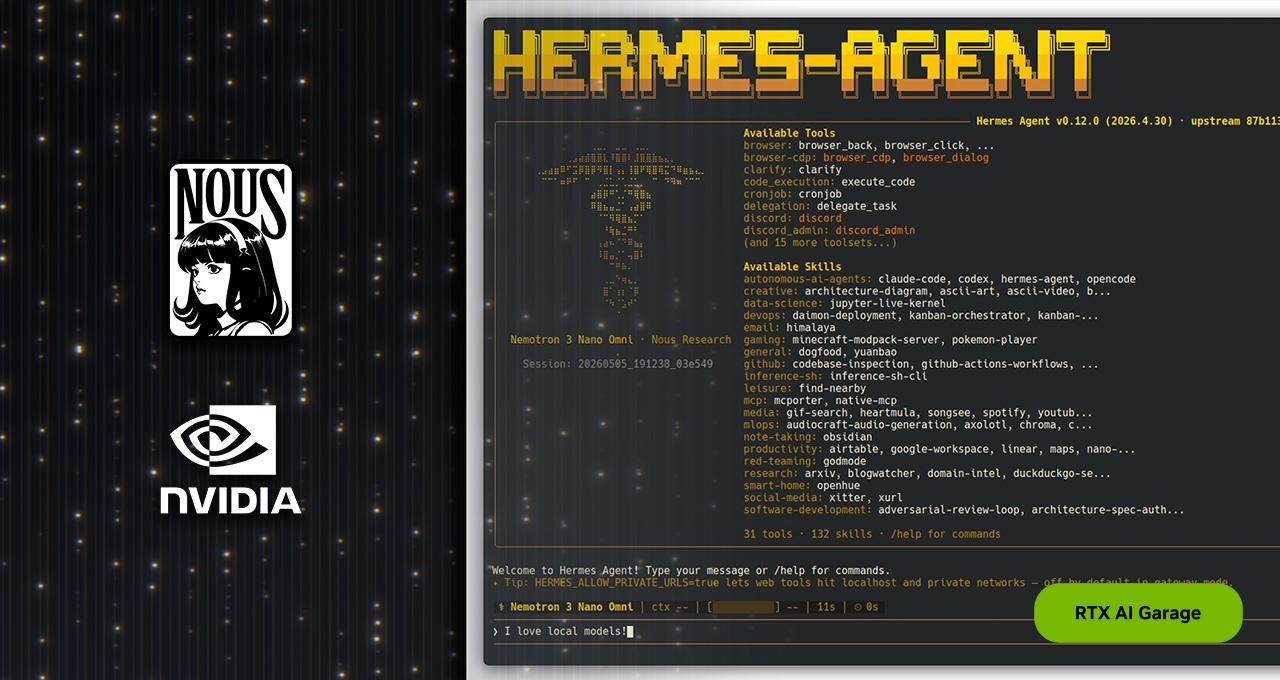
Agentic AI is transforming how we tackle tasks, and two recent developments are capturing the spotlight: the self-improving Hermes Agent and the powerful Qwen 3.6 language models. Built by Nous Research, Hermes has quickly become the most-used agent on platforms like OpenRouter, thanks to its reliability and unique ability to learn from its own actions. Meanwhile, Alibaba’s Qwen 3.6 models deliver data-center-grade performance directly on your local machine—especially when paired with NVIDIA RTX GPUs or the DGX Spark. This Q&A dives into what makes these technologies tick and how they work together to bring smarter, faster, always-on AI to your PC.
What is Hermes Agent and why is it gaining such rapid popularity?
Hermes Agent is an open-source framework developed by Nous Research, designed to run reliable, self-improving AI agents locally. Within just three months of its release, it crossed 140,000 GitHub stars and, according to OpenRouter, became the most-used agent worldwide. Its popularity stems from its unique blend of features: it is provider- and model-agnostic, meaning it works with various AI models and services, and it is optimized for always-on use on local hardware. This makes it an ideal choice for users who want persistent, autonomous agents without relying on cloud servers. The community has embraced Hermes because it reduces the typical debugging overhead of other agent frameworks, delivering consistent performance even with local models of moderate size. The combination of reliability, self-improvement capabilities, and adaptability has positioned Hermes as a leading solution in the fast-growing field of agentic AI.
How does Hermes Agent achieve self-improvement through self-evolving skills?
One of Hermes’ standout features is its ability to write and refine its own skills over time. Every time the agent tackles a complex task or receives user feedback, it saves that experience as a new skill. This means Hermes doesn’t just follow static instructions; it actively learns from each interaction. For example, if a user asks the agent to organize a large folder of files and then gives tips on better naming conventions, Hermes will incorporate that feedback into a reusable skill for future file management tasks. This continuous loop of action, feedback, and skill creation allows the agent to improve without manual reprogramming. Over weeks of use, the agent becomes more efficient and accurate, adapting to the user’s specific workflows. This self-evolving capability is a major leap forward from traditional agents that require extensive manual curation of behaviors, making Hermes both more flexible and easier to maintain.
What are contained sub-agents and how do they improve Hermes’ performance?
Contained sub-agents are temporary, isolated workers that Hermes spawns for specific sub-tasks. Each sub-agent has its own focused context and a limited set of tools, allowing it to complete its assigned piece of work independently without interfering with the main agent’s state. Think of it as a manager (the main agent) assigning a short-term team (the sub-agent) to handle a particular problem. For instance, while the main agent manages an email inbox, it might create a sub-agent to sort through a specific folder for attachments, then terminate that sub-agent once done. This design keeps the overall task organization tidy and prevents context overflow—a common problem in AI agents where the model’s attention window gets cluttered with irrelevant information. As a result, Hermes can run efficiently with smaller context windows, which is especially beneficial for local language models that often have limited memory. The approach reduces confusion, speeds up processing, and makes Hermes ideal for hardware with constrained resources.
How does Hermes ensure reliability compared to other agent frameworks?
Reliability in Hermes comes from a rigorous curation and testing process by Nous Research. Every skill, tool, and plug-in that ships with the agent is individually vetted and stress-tested before release. This means that users can trust that each component will work as intended, even when combined in complex workflows. In contrast, many other agent frameworks rely on community-submitted tools without such quality control, leading to frequent debugging and compatibility issues. Hermes is designed to “just work” even with local models in the 30-billion-parameter class, which are often less capable than larger models. The result is a dramatically smoother user experience—less time troubleshooting, more time getting work done. By proactively eliminating broken or unpredictable components, Hermes raises the bar for what users can expect from a local agent, making it a reliable choice for both developers and non-technical users.

Why does Hermes produce better results with the same underlying model compared to other frameworks?
When developers compare identical language models running in Hermes versus other frameworks, Hermes consistently yields stronger outcomes. The secret lies in its architecture: Hermes functions as an active orchestration layer, not a thin wrapper. While many frameworks simply pass tasks to a model and collect responses, Hermes actively manages the agent’s execution flow, memory, and skill usage. It maintains persistent state across multiple interactions, allowing the agent to remember past decisions and build upon them. For example, if an agent is managing a project, Hermes can orchestrate a sequence of sub-tasks—research, drafting, organizing—without losing context between steps. This persistent, on-device approach means the agent isn’t restarting from scratch each time; it learns and adapts continuously. The result is more coherent and context-aware outputs that feel less like isolated responses and more like the work of a knowledgeable assistant. This framework-level optimization is why the same model performs better inside Hermes.
How does Qwen 3.6 push the boundaries of local AI capabilities?
Qwen 3.6, developed by Alibaba, represents a major leap in local AI performance. The new 35-billion-parameter model runs on approximately 20GB of memory—less than a third of what previous 120-billion-parameter models required—yet it outperforms those larger predecessors. Similarly, the new 27-billion-parameter dense model matches the accuracy of the earlier 400-billion-parameter model. This is achieved through architectural improvements that maximize active parameter efficiency. For users, this means they can run cutting-edge AI intelligence on a single NVIDIA RTX GPU, without needing expensive data-center hardware. The models are open-weight, allowing developers to fine-tune and customize them. Combined with Hermes Agent, Qwen 3.6 enables complex, self-improving agents that run entirely on your local PC, giving you the power of state-of-the-art AI in a private, always-available package. This democratization of AI capabilities is expected to accelerate applications in coding, analysis, creative work, and personal productivity.
What hardware is best suited for running Hermes and Qwen 3.6 locally?
Hermes Agent and Qwen 3.6 are optimized for local execution, meaning hardware quality directly impacts user experience. NVIDIA RTX GPUs, such as those found in RTX PCs and RTX PRO workstations, are purpose-built for the parallel compute demands of AI inference and training. For running the Qwen 3.6 35B model, approximately 20GB of memory is needed, which is easily accommodated by high-end RTX cards. For more demanding workloads or longer context windows, the NVIDIA DGX Spark—a specialized AI supercomputer—provides even greater performance for around-the-clock agent operation. The hardware accelerates the agent’s self-improvement cycle, allowing it to process complex tasks faster. Users with lower-end GPUs can still run smaller models like Qwen 3.6 27B, which offers excellent performance with less memory. Ultimately, the combination of Hermes Agent, Qwen 3.6, and NVIDIA hardware creates a powerful, locally autonomous AI that stays responsive and private, ideal for professionals who need persistent assistance without cloud dependencies.